Do you find chemical terms like "amphoteric" on specification sheets confusing? This single word can make it hard to judge a material’s true potential, leaving you wondering if it’s the right choice for your application.
Aluminum hydroxide, Al(OH)₃, is called amphoteric because it has a unique chemical ability to react with and neutralize both strong acids and strong bases. This dual reactivity is its most important chemical characteristic.
This dual nature1 isn’t just a fun fact for chemists; it’s the key to its usefulness in many different industries. Whether it’s safely neutralizing stomach acid in medicine or acting as a component in complex industrial processes, this property is what makes it so valuable.
As someone who manages the production of this powder, I see firsthand how this property is used by our customers. Let’s look at why this happens and what it means for the products you buy every day.
Why is aluminium hydroxide amphoteric?
It seems strange that one substance can behave like two complete opposites. This chemical flexibility is precisely what makes aluminum hydroxide so useful, but how does it actually work?
Aluminum hydroxide is amphoteric because its structure allows it to react differently depending on its chemical environment. With acids, it acts as a base. With strong bases, it acts as an acid, demonstrating a "two-faced" chemical personality.
Let’s dive deeper into the two reactions. This is what makes it perfect for a pharmaceutical buyer like Mr. Park. Its ability to act as an antacid is a direct result of being amphoteric.
First, let’s see how it reacts with an acid, like hydrochloric acid (HCl) found in the stomach:
Al(OH)₃ + 3HCl → AlCl₃ + 3H₂O
In this reaction, the aluminum hydroxide acts as a classic base. It consumes the strong acid and neutralizes it, producing a harmless salt (aluminum chloride) and water. This brings immediate relief from excess stomach acid.
Now, let’s see what happens when it’s mixed with a strong base, like sodium hydroxide (NaOH):
Al(OH)₃ + NaOH → Na[Al(OH)₄]
Here, it does the opposite. It acts like an acid, reacting with the strong base to form a soluble complex called sodium tetrahydroxoaluminate. This ability to react with strong bases is essential in industrial processes, such as the famous Bayer process2 used to refine it from ore in the first place. At my factory, we ensure the purity of our Al(OH)₃ so these reactions are clean and predictable for our customers.
Why is aluminium oxide called an amphoteric?
Now that we understand aluminum hydroxide, what about its close relative, aluminum oxide? This is the material our powder becomes if you heat it, so knowing its properties is also very important.
Aluminum oxide (Al₂O₃) is also called amphoteric because it shares the same ability to react with both strong acids and strong bases. However, it is much less reactive and usually requires heat to get the reactions started.
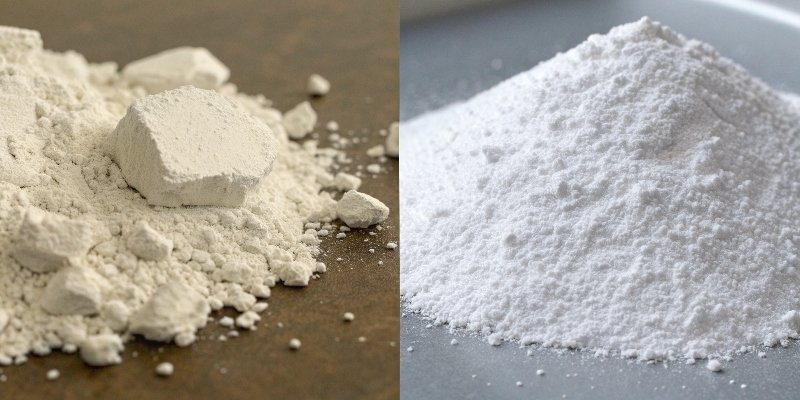
This distinction is crucial. You wouldn’t use hard ceramic alumina as an antacid. Its amphoteric3 nature is used in completely different, high-temperature applications. Let’s look at its own set of reactions.
When reacting with acid4:
Al₂O₃ + 6HCl → 2AlCl₃ + 3H₂O
You can see the result is the same as with the hydroxide, but because alumina is a very hard, stable crystal, this reaction is much slower and often needs heat.
When reacting with a strong base:
Al₂O₃ + 2NaOH + 3H₂O → 2Na[Al(OH)₄]
Again, this is the same outcome but under different conditions. This property is vital in the production of ceramics5 and as a catalyst support in the chemical industry. The surface of the alumina can interact with both acidic and basic molecules, making it an ideal platform for complex chemical reactions6. In fact, the entire Bayer process we use to produce aluminum hydroxide relies on this property. We use a strong base to dissolve the compound from its ore and then change the conditions to make it precipitate out again.
Why is aluminium said to be amphoteric?
We’ve covered the compounds, but what about the familiar aluminum metal itself? The foil in your kitchen and the frames of windows don’t seem to react with much, so it’s surprising to hear they are also amphoteric.
Aluminum metal is considered amphoteric because the pure metal reacts with both acids and bases. This reactivity is normally hidden by a very thin, tough, and non-reactive layer of aluminum oxide (Al₂O₃) that forms instantly in air.

This tough, invisible skin is the hero of aluminum’s story. It’s what protects the very reactive metal underneath from corroding in neutral environments like water or air. But strong acids or strong bases can destroy this protective layer.
When the protective layer is broken, the metal underneath is exposed and can react.
- Reaction with Acid: An acid first dissolves the oxide layer, then attacks the metal. This reaction produces hydrogen gas7.
2Al + 6HCl → 2AlCl₃ + 3H₂ - Reaction with Base: A strong base also dissolves the protective oxide layer8 and then reacts with the aluminum metal, also producing hydrogen gas.
2Al + 2NaOH + 6H₂O → 2Na[Al(OH)₄] + 3H₂
This is why you should never use strong, alkaline-based oven cleaners on aluminum baking sheets or cookware. The cleaner will eat through the protective layer and corrode the metal, leaving it dark and pitted. This proves that even the shiny metal we see every day has a hidden amphoteric3 nature.
Why are they called amphoteric?
After all this, you might wonder where this strange word even comes from. It’s a technical term, but like many scientific words, its origin gives a very simple clue to its meaning.
They are called "amphoteric" from the Greek word amphoteros, which literally means "both." The name is a perfect description of the chemical’s dual nature—its ability to behave in both ways, as an acid and as a base.

Let’s break down the word origin, because it makes it much easier to remember. The Greek prefix amphi- means "on both sides" or "of both kinds." We see this in other words:
- Amphibian: An animal that lives both on land and in water.
- Amphitheater: A theater where the audience sits on both sides of the stage.
So, an "amphoteric" substance is a chemical that can play for "both teams," acid and base. It’s not a rare property, but it’s a very useful one.
| Substance | Formula | Acts Like a Base with | Acts Like an Acid with |
|---|---|---|---|
| Aluminum Hydroxide | Al(OH)₃ | Acids (HCl) | Bases (NaOH) |
| Water | H₂O | Acids | Bases |
| Zinc Oxide | ZnO | Acids | Bases |
| Amino Acids | (complex) | Has both acid/base groups | Has both acid/base groups |
For a buyer, understanding this "both ways" behavior explains why a material like aluminum hydroxide is so versatile. It’s not just a filler; it’s an active chemical tool.
Conclusion
In simple terms, "amphoteric" means a substance reacts with both acids and bases. This amazing dual ability is why aluminum and its compounds are so incredibly useful across so many different industries.
-
Understand the concept of dual nature in amphoteric substances and its practical implications. ↩
-
Learn about the Bayer process, a key method for refining aluminum from its ore. ↩
-
Understanding the term ‘amphoteric’ is crucial for grasping the dual nature of certain substances in chemistry. ↩ ↩
-
Understand the reaction of aluminum oxide with acids and its implications in chemical processes. ↩
-
Find out how aluminum oxide’s properties make it essential in ceramic production. ↩
-
Gain insights into the various chemical reactions that amphoteric substances can undergo. ↩
-
Learn about the chemical reactions involving aluminum that produce hydrogen gas. ↩
-
Discover the importance of the protective oxide layer that shields aluminum from corrosion. ↩

You may also be interested in:

What protective measures should be taken when handling aluminum hydroxide powder in a factory?
Are you worried about worker safety when handling fine powders? Aluminum hydroxide is generally safe, but mishandling its dust can lead to serious respiratory issues and even create explosive conditions.

What Key Technical Indicators Should Be Considered When Purchasing Aluminum Hydroxide?
Are you struggling to find the right aluminum hydroxide for your needs? You might be paying for features you don’t even require. Let’s simplify the technical details. When buying aluminum

What are the market trends for aluminum hydroxide in 2026?
Are you planning your 2026 raw material purchases? Volatile markets make it hard. I will share insights from the factory floor to help you make better decisions for your business.
Is aluminum hydroxide toxic and is it harmful to the human body?
Worried about the word "aluminum" in your products? It sounds scary and can make you question its safety. I’m here to clear up the confusion with simple facts. Aluminum hydroxide

What are the side effects of long-term use of stomach medications containing aluminum hydroxide?
Struggling with constant heartburn? Reaching for that stomach medicine might seem like the only option. But what if that relief comes with hidden long-term costs? The most common side effect

Does ingesting aluminum (such as through aluminum hydroxide) cause Alzheimer's disease?
Are you worried that everyday products containing aluminum might be harmful? This fear connects to serious health concerns like Alzheimer’s, making you question what is safe. Let’s look closely. Based

Why do some vaccines contain aluminum hydroxide (aluminum adjuvant)?
Confused about vaccine ingredients? Seeing aluminum hydroxide listed can be unsettling. I’ll explain its crucial role and why it’s there to help your body build strong immunity. Aluminum hydroxide acts

Is the aluminum adjuvant in vaccines safe for infants or adults?
You read about vaccine ingredients and worry. The word "aluminum" sounds scary, especially when talking about babies. But understanding the facts can give you peace of mind. Yes, the aluminum

What environmental problems are generated during the production of aluminum hydroxide?
Worried about environmental compliance in your supply chain? Sourcing from China can be complex. You need a reliable, eco-conscious partner for your aluminum hydroxide needs. The main environmental issue is

Where are China's main aluminum hydroxide production areas?
Are you struggling to find the right aluminum hydroxide supplier in China? This confusion can lead to higher costs and unstable quality, which hurts your business and your reputation. China’s